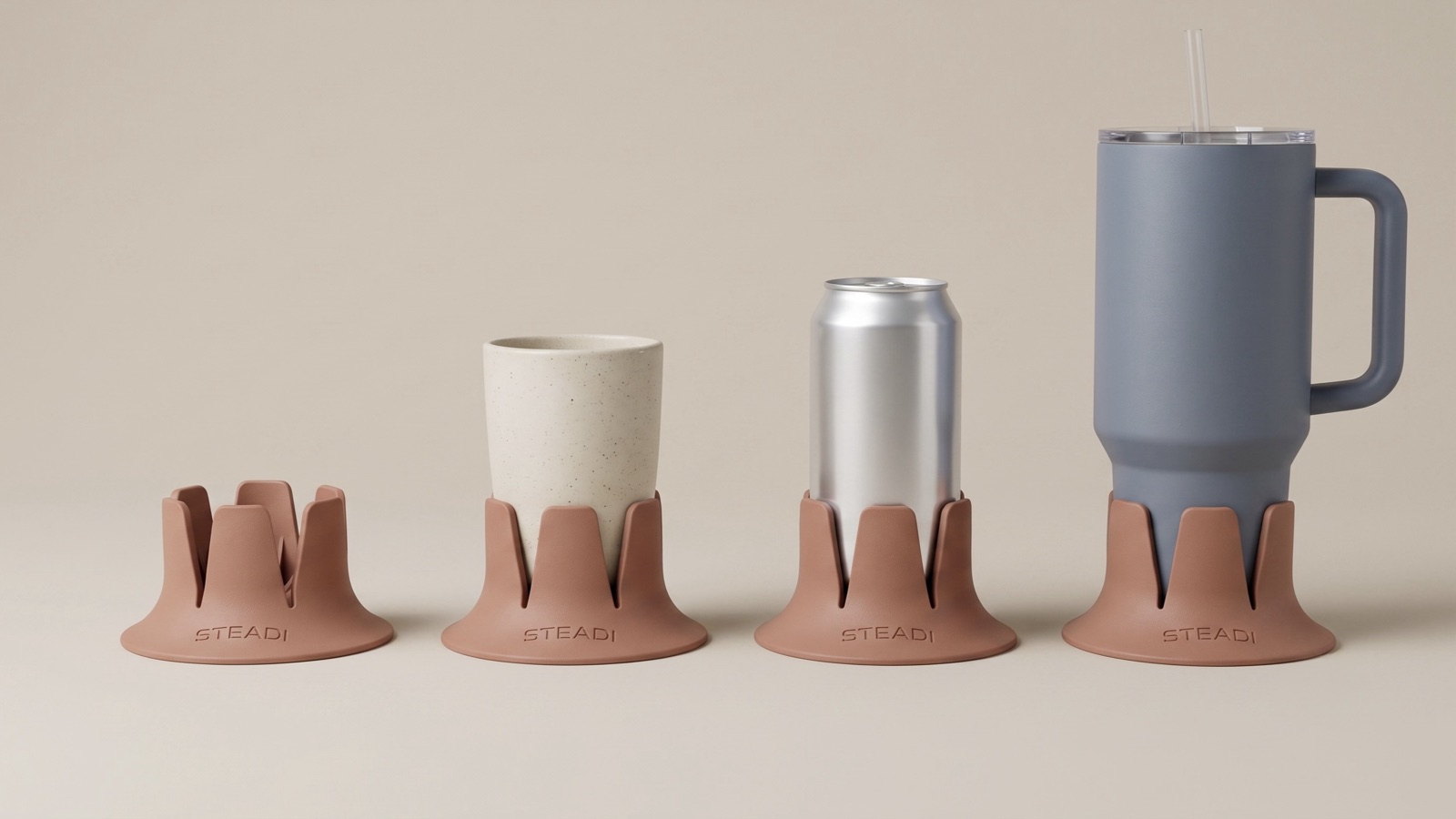
Finally, somewhere to put your drink besides the pool deck.
A flexible base that holds your can, cup, or tumbler steady right on the chaise — the sling seat, the towel, or the deck beside it — for the drink that always ends up on a hot, sloped surface the moment the one shared side table is taken.
One flexible base. Empty, then a cup, a can, and a 40 oz tumbler — the same grip on sling mesh as it holds on concrete.
The situation
The chaise was built to hold you, not your drink.
Lie back on a pool chair and look for somewhere to set a drink — there isn't one, unless your backyard came with a swim-up bar. What's actually on offer is a short list of bad options, and you already know every one of them.
The deck below your elbow
A chaise sits barely a foot off the ground, so the deck beside it is the obvious spot for a can — except pool decks are graded for drainage by code, so it's standing on a slope, in the splash line, on concrete that's climbed past 140°F by mid-afternoon.
The armrest, on the chairs that have one
Plenty of pool loungers skip arms entirely — review roundups flag the missing drink holder as a standard complaint. The ones with arms offer a rounded aluminum tube or a slat narrower than any can. Nothing about the classic sling chaise was built to hold a container.
The towel underneath everything
Terry cloth bunches into soft folds the moment it's draped over sling or cushion. A can set on top doesn't sit level — it heels over slowly as the folds compress, and every drop of condensation goes straight into the one dry towel you brought.
The wind
A half-empty can, bottle, or cup is nearly weightless, and there's rarely anything at pool level to block a breeze. Floating holders drift off across the water for the same reason — light containers on light surfaces don't stay where you left them.
The tanning ledge
Sit in a chair on the Baja shelf and there's no version of a table anywhere near you — every surface in reach is underwater, wet coping, or a floating holder that's already drifted off. It's the one spot at the pool with nothing dry to offer at all.
It's not a crisis at any point along the way — just the same short list of bad options, offered back to you again each time you sit down poolside.
You know the moment
This is already how a pool day goes.
Two minutes after sunscreen
Arms still slick with SPF, you reach down off a chaise that's barely a foot high for the can you set on the sloped deck below — and the grip you needed was never going to hold.
The cannonball, any Saturday
A kid announces it before it happens. Everything within a body-length of the edge takes the spray, including whatever's standing on the deck beside your chair.
The recline click
Dropping the chaise back a notch means lifting your weight off the sling for a second — the mesh re-tensions, the towel underneath it shifts, and the seltzer you parked by your hip goes over before you're flat again.
Before 7 AM
Some chair hog has already draped a towel across the two loungers with the shade, or the view of the shallow end. Whichever chaise is left is the one you get — armrest or no armrest, side table or none.
The walk back from the water
Dripping, picking your way across hot concrete back to your chair, and the drink you left is wherever the slope carried it — warm, sitting in a puddle, propped against a wet towel.
What you get
Three reasons it stays out.
01
Grips the moving stuff — mesh, towel, and all
The wide flexible base spreads across sling mesh or a folded towel instead of trying to balance on a point of it. Recline the chair, shift your weight, let a kid cannonball nearby — the base flexes with whatever's under it and the drink settles back.
02
Holds what's actually allowed at the pool
Cans, plastic cups, and lidded tumblers — the whole list glass can't be, since glass is banned at nearly every pool. Cans and bottles slide on; cups and tumblers drop in through the fins and get held by the bottom inch.
03
Doesn't care which chair you got
No arm to clip to, no frame tube to match, no bracket sized for one lounger style. It sits on the sling seat, the towel, or the deck beside you — whichever chaise was still open when you got there.
The fit test
The whole fit test fits in your pool bag.
your cup's base lands in here
A square sticky note: 3 inches, exactly.
01
Bring a sticky note to the pool.
The classic square is exactly 3 inches on a side — a fact about sticky notes, and it happens to be the exact ceiling of what fits.
02
Stand your can or cup on it, sunscreen hands and all.
Look at the base, not the rim — a tapered party cup or an insulated tumbler can be twice as wide up top. The base is the only measurement that decides whether it settles on sling mesh or a towel.
03
Read the note.
Base sits inside the square? It fits. Hangs over the edge? Too wide. A tiny footprint lost in the middle — under about 2 inches? Too narrow.
No ruler, no spec sheet, no guessing poolside — one sticky note, one glance, with the can you're actually bringing outside.
Will it fit my cup
Measure the bottom, not the top.
The rule is one line: a container base about 2 to 3 inches across settles in. Every verdict below follows from it — and since glass doesn't make it past the gate at most pools, most of this list is exactly what you're already carrying out there.
40 oz Stanley-style Quencher fits
Slim hard-seltzer can fits
Standard 12 oz can in a koozie fits
Red Solo-style party cup fits
20-30 oz insulated tumbler fits
16.9 oz plastic water bottle fits
Kids' juice box or pouch too irregular
Stemless plastic wine tumbler fits
Coffee mug, handled handle blocks the fins
There's a floor as well as a ceiling — under about 2 inches, the base sits too loose to grip. The one honest non-fit on this list is the handled mug: the base itself would sit fine, but the handle is exactly where a fin needs room to close.
How it works
Three parts, no moving parts.
The base spreads out.
Sling mesh and a folded towel don't offer a flat plane anywhere — a narrow base tips the moment the surface shifts. The wide flexible base lies across the weave or the folds instead of balancing on top of them.
The fins grip.
Flexible fins hold the can or cup by its bottom inch, so a gust, a shift, or a reach with sunscreen-slick hands doesn't walk it off the edge.
It settles.
The chair reclines a notch, the mesh re-tensions, someone sits down at the foot of the lounger — the base flexes with the surface and brings the drink back level.
Nothing straps to the armrest. No bracket sized for one armrest style, no strap that needs an arm to loop around, no clip for round zero-gravity tubing. It sits on top of whatever chaise you're on — sling, cushion, or resort lounger — and works the same on the deck or the grass beside it.
The pool deck, surface by surface
Nothing poolside sits still — including the ground.
The reason a drink doesn't last poolside isn't carelessness. Every surface within reach is soft, sloped, wet, or moving before you've even sat down.
Sling seat (Textilene mesh)
Woven vinyl-coated mesh stretched tight over an aluminum frame — it flexes under every shift of weight. Set a can beside your hip and the mesh re-tensions the moment you recline or sit up; there's no flat plane on it anywhere.
The beach towel
Draped over the seat, terry cloth bunches into folds instead of lying flat, and slides on the smooth fabric underneath it. A drink set on top heels over slowly as the folds compress — and soaks up every drop of condensation.
The pool deck
Concrete or a cool-deck coating, poured with a drainage slope on purpose — the ground here is never quite level, by code. In direct summer sun, bare concrete climbs past 140°F, warming anything left standing on it.
Grass at the yard's edge
Soft, uneven, and often damp from splash-out, with dips hidden under the blades. A tapered cup has almost no chance leaning on ground that gives way on one side before the other.
Versus what you do now
The workarounds everyone's already tried.
Clip-on and strap-on chair cup holders
Every design mounts to exactly one style of arm or frame — brackets need a flat Adirondack-style arm, straps need an armrest to loop around, clips need round zero-gravity tubing. Buying guides tell shoppers to check their exact chair model first, and the classic sling chaise — curved arms or none at all — fits none of them.
Floating drink holders
Reviewers report the same pattern: they wobble or tip once loaded, and drift off in wind or busy water badly enough that the accessory market now sells tethers and anchor clips just to keep them close. The drink ends up watered down, warm, or on the far side of the pool.
The patio side table
It needs a level spot on a deck that's graded on purpose. Roundups of tables that 'refuse to wobble' sell leveling feet and sand ballast to fix the same admission: light tables rock on sloped concrete and move in wind — and at a crowded pool, there's often one table shared between two or three loungers.
Balancing it on the cooler lid
Cooler lids are domed, textured, or hinged, not flat, and the lid disappears each time someone opens it for ice. The cooler also sits wherever the ice is, which is rarely beside your particular chair.
Before you buy
Questions people actually ask.
Does it actually work on sling mesh?
That's the surface it's built for. Soft, moving surfaces are its strongest case — the wide flexible base spreads across the weave instead of trying to balance on a point of it, and the fins keep the drink from rattling loose when the chair reclines or the mesh re-tensions.
What about wind? Everything blows over out here.
A lightweight can or bottle is exactly what tips first in a breeze, and this changes that math — the base is wide enough and the fins grip enough that a gust rocks it instead of walking it off the edge. It resists tipping; a direct hard knock is still a direct hard knock.
Will my cup or can actually fit?
Measure the base, not the rim. A base about 2 to 3 inches across settles in — the 40 oz Stanley Quencher does. A handled mug doesn't; the handle sits where a fin needs to close.
Does it clamp onto the chair?
No. Nothing clips to an arm, straps around a frame, or needs a specific chair model to fit. It sits on top of whatever you're on — sling seat, cushion, towel, or the deck beside you.
Does it work on the deck itself, not just the chair?
Yes — it holds at least as well on hard, flat surfaces as it does on soft ones. Set it on the concrete or the coping beside your chair and the same wide base and grip apply.
What if it ends up in the pool?
It doesn't float, so if it goes in, it sinks to the bottom like anything else you'd want to fish back out. It's fine soaked through and rinses clean — just don't count on it bobbing back to you on its own.
Does it stop the wasps?
No — that's a separate problem. What it does is keep the can from tipping over on the deck between sips; if wasps are bad that week, pair it with a lid or a can cover for the rest of it.
How do I clean it after a day at the pool?
Rinse off the chlorine and sunscreen, or run it through the dishwasher. It's one piece of flexible material with nothing to take apart.
Who makes it, and where do I buy one?
It's called the Steadi, molded in small runs in Orange, California by Steadi Labs — veteran-founded and patent pending. Every order ships free from steadilabs.com, with 30 days to change your mind.
Who makes it
Made start to finish in Orange, California.
The maker is Steadi Labs, a small veteran-founded company in Orange, California. It's injection molded — the mold, the material, and the color runs all sit within about three and a half miles of the shop, and every batch is molded there in small runs. The people who make it are the same people who answer hello@steadilabs.com.
Thirty days, wherever you use it.
Use it for a month. If it doesn't do what this page says, email hello@steadilabs.com and it gets made right — no forms, no fight.
Veteran-founded · Patent pending · Made in Orange, California
Keep it right there on the chaise.
The can stands beside you on the lounger — off the sloped concrete, out of the splash line — so the walk back from the water doesn't end with a warm drink sitting in a puddle.